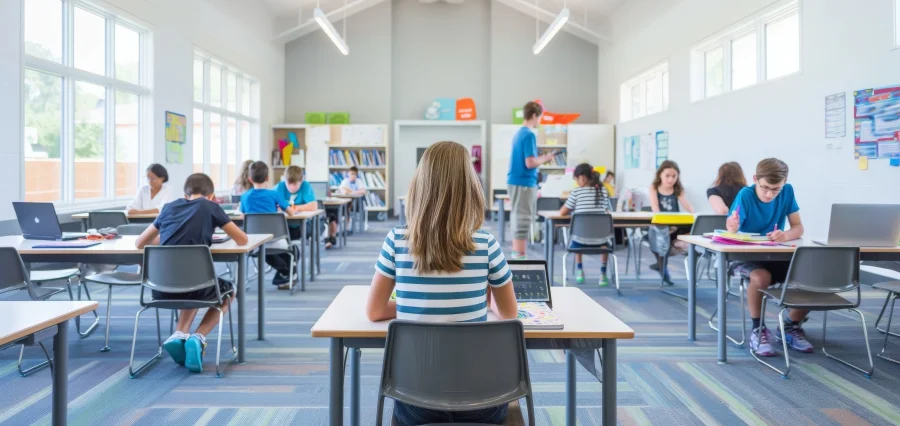
Education has been a key priority for India since the beginning. Families in the nation have been sacrificing a lot to enrol their kids in educational institutions for several decades now. The passion for education hasn’t dwindled yet. On the contrary, it has become even more intense. The K-12 educational system in India today caters to over 260 million children daily in more than one and a half million schools located all over the nation.
This is because 260 million is a figure larger than the entire population of many nations around the globe. What happens inside these schools, how children are taught, what they learn, and whether they actually understand it, shapes not just individual lives but the future of the nation itself.
This blog discusses the structure, the scale, and the changing landscape of the K-12 school ecosystem in India, and why it matters to parents, educators, and organisations working in this space.
What Is a K-12 School?
The K-12 school is defined as the total process of education right from the Kindergarten level, at about three to four years, till Class 12, at about seventeen to eighteen years. All stages before college are considered under this category.
In India, this process includes the pre-primary level, followed by Classes 1-5 in the primary, Classes 6-8 in the middle, Classes 9 and 10 in the secondary, and Classes 11 and 12 in the senior secondary levels. The National Education Policy of 2020 has reorganised this into four learning stages, namely Foundational, Preparatory, Middle, and Secondary, each built around how children actually develop at different ages rather than just administrative groupings.
The Scale of the System
Numbers tell part of the story here. The Indian market for K-12 education is estimated to be worth USD 103 billion in 2025 and will be worth around USD 276 billion by 2034. The total education budget of the central government stands above Rs. 1.28 lakh crore.
Around 82 per cent of schools in India are located in rural India. Around 54 per cent of the total market is controlled by government-run educational institutions, while private schools make up the other 46%. The real promise and the benefits of K-12 school education can only be fully realised when quality reaches every corner of the country, not just its urban centres.
Understanding the Board System
One unique characteristic of India that differentiates it from other nations is the system of multiple boards. While in other countries there is only one national curriculum, in India, many boards operate simultaneously, each of which has a different curriculum and examination system.
For instance, CBSE stands for the Central Board of Secondary Education, which uses NCERT books and is selected by people who wish their children to give national entrance examinations like JEE or NEET. The ICSE provides a thorough curriculum with emphasis on English and is usually chosen by those families who intend to study abroad. The state boards, which exist for each of the states, constitute the highest number of students taught in their regional languages and syllabi designed for their local entrance examinations.
Choosing a board is often a long-term family decision. It affects not just what a child studies but how they prepare for life after school.
The Learning Gap That Cannot Be Ignored
Getting children into school is no longer the central challenge for India. The harder question now is whether children are actually learning once they are there. The Annual Status of Education Report for 2024, widely known as ASER, found that a significant number of Class 3 students could not read a Class 2 level text. Many children in Class 5 could not solve basic arithmetic problems.
Getting a child through the school gate is one thing. Making sure that the child actually learns while inside is another. India has made real progress on the first. The second is where attention, effort, and honest accountability need to go now. The stakeholders making real progress are the ones focused on this specific problem.
The Role of Technology
Technology has moved from being an add-on to becoming a genuine part of how schools operate in India. Government platforms such as DIKSHA and PM e-VIDYA have brought structured digital content into government schools at a meaningful scale. Private platforms are using data and artificial intelligence to create more personalised learning experiences for students.
The benefits of K-12 school education are being extended through these tools in ways that were not possible a decade ago. Kids in smaller towns, and even more rural districts, are now able to reach solid instruction that, before, was limited to huge cities. Roughly 89% of rural teenagers have a smartphone at home. The infrastructure for digital learning is growing. The opportunity lies in making that access count.
Why This Sector Matters Beyond Education
The K-12 school sector connects directly to how India’s workforce develops, how its economy grows, and how opportunity is distributed equitably across society. Every improvement in learning quality, at scale, has long-term consequences for productivity and innovation.
Organisations that engage seriously with this ecosystem, whether as solution providers, investors, or partners in delivery, are participating in something that extends far beyond a single industry. The K-12 school in India is not just a place where children learn. It is where the country’s future is quietly being built, one classroom at a time. At scale, the benefits of K-12 school education translate directly into a more skilled workforce, stronger communities, and long-term economic growth.
Conclusion: A System Worth Understanding and Investing In
India’s K-12 school ecosystem is large, complex, and genuinely at a turning point. Enrollment has grown. Policy ambition is high. Technology is opening new possibilities. The benefits of K-12 school education are reaching more children than ever before, though the journey toward consistent quality across all schools and all regions is still very much underway.
For anyone working in education, partnering with schools, or trying to understand where this sector is headed, the starting point is simple. Understand the scale. Respect the complexity. And recognise that improving what happens inside a classroom for a child in rural India is one of the most important problems anyone can work on right now.
Read Also : Global Education Leadership Trends Reshaping Modern Learning Systems