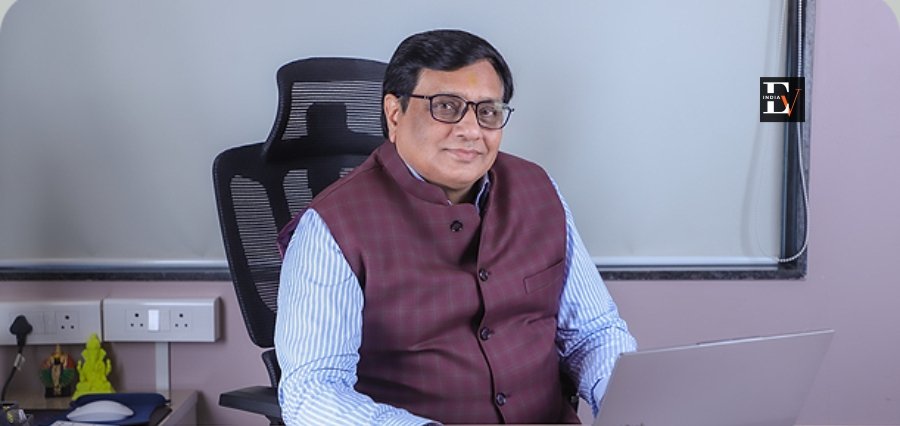
Amidst the rapidly changing environment in Indian higher education, which faces a perennial struggle between maintaining its traditional essence while trying to transform, one leader who has made an illustrious career out of an extremely straightforward belief about higher education is Prof. (Dr.) Manish Bhalla, who leads the charge at D Y Patil International University (DYPIU), Akurdi, Pune, as its Vice Chancellor, bringing to the table more than three decades of teaching, research, quality assurance, and governance experience at an institution which was established in 2018 but which has already managed to carve a place for itself among the most progressive of India’s higher education institutions.
Indian higher education has been under pressure for close to a decade now to reinvent itself in light of disruptive technologies and universities which disrupt the conventional norms of higher education by offering students career opportunities and not just degrees. One leader who deals with the pressure to transform gracefully is Prof. (Dr.) Manish Bhalla, who does not see disruption as a challenge but rather the norm.
His professional life has never taken a singular path. He has been a professor, a researcher, a Registrar, and an innovator whose job included auditing the very process that keeps universities accountable. It is this variety of experience, according to Dr. Bhalla, that has made him well-suited for the intricacies of managing a relatively new and forward-looking university. Every position, he emphasizes, has reaffirmed the same principle: that education, research, governance, and innovation cannot be treated as separate units striving to draw more attention from everyone else, but have to act as an inseparable engine.
Joining a Future-Ready University
When Prof. (Dr.) Manish Bhalla joined DYPIU, he inherited not a legacy institution resistant to change, but a young university unusually eager to embrace it. Rather than adapting old academic templates to new demands, DYPIU had already begun building programmes designed for a future still taking shape, spanning Artificial Intelligence and Machine Learning, Cyber Security and Forensics developed in partnership with IBM, Semiconductor Engineering, and Quantum Computing. For a leader who has spent decades watching institutions struggle to modernize, this willingness to build forward rather than retrofit backward was the opportunity that drew him in.
His vision for the university rests on three interlocking pillars: preparing graduates who can solve problems that do not yet fully exist, integrating research so closely with industry that the line between classroom and workplace begins to blur, and embedding quality assurance into every institutional process rather than treating it as an annual formality. Yet beyond frameworks and strategy documents, what animates him most is something more personal. He speaks with particular energy about first-generation learners, students who arrive at university as the first in their families to do so, and the transformation he witnesses as they develop the confidence to compete on a global stage.
The Four Pillars of Academic Excellence
Ask him what drives academic excellence at DYPIU, and he will not point to rankings first. He points to four guiding principles that, in his view, must operate simultaneously rather than in isolation. Relevance comes first: every programme, he insists, must equip students with practical, career-ready competencies rather than purely theoretical knowledge. Industry integration follows closely behind, with collaborations such as those with IBM and Dassault Systèmes giving students direct exposure to advanced technologies and real-world practices long before graduation. Interdisciplinary education forms the third pillar, with DYPIU’s multidisciplinary schools and its Centre for Innovation, Incubation & Entrepreneurship deliberately bringing together students from engineering, management, design, biosciences, media, and the liberal arts to collaborate on problems that no single discipline could solve alone. Finally, continuous quality improvement threads through everything, with feedback from students, alumni, employers, and faculty constantly reshaping curriculum and institutional direction.
Reimagining Higher Education
This emphasis on systems over slogans becomes clearer when Prof. (Dr.) Manish Bhalla discusses the broader transformation he believes higher education must undergo. In his assessment, the sector is moving decisively beyond degrees as the sole marker of readiness, toward demonstrated capability as the real currency of employability. Employers today, he notes, are weighing innovation, problem-solving, and adaptability alongside academic qualifications, not instead of them. He is equally emphatic that emerging fields such as Artificial Intelligence, Semiconductor Engineering, Quantum Computing, and Cyber Security cannot remain specialised electives tucked away in advanced semesters; they must become part of mainstream education from the outset. For universities to keep pace, he argues, they need industry partnerships that go far deeper than guest lectures, extending into curriculum design, joint research, and structured internships.
“Universities must also strengthen long-term industry partnerships where companies actively contribute to curriculum design, research, internships, and experiential learning,” he asserts.
That statement frames collaboration not as an optional enhancement but as a structural necessity for institutions preparing students for a genuinely global economy.
Research, Innovation, and Industry Ties
That global orientation runs through nearly every initiative he describes. DYPIU’s research strategy, still in its formative years, has deliberately prioritised building strong infrastructure before chasing large-scale outcomes, a sequencing choice that reflects institutional patience rather than urgency for headlines. Applied research already threads through programmes in Bioengineering, Medical Biotechnology, and Medicinal Chemistry, while the university’s Centre for Innovation, Incubation & Entrepreneurship gives students a pathway to convert ideas into ventures while still pursuing their degrees. The Digital Engineering and Digital Manufacturing Experience Centre, developed jointly with Dassault Systèmes, exposes students to virtual twins, simulation, and smart manufacturing technologies that most undergraduates elsewhere encounter only after entering the workforce. Partnerships with IBM, Quadrogen Power Systems, and Aryabhatta Knowledge University, among others, keep research, curriculum, and industry engagement tightly interconnected rather than running on parallel, disconnected tracks.
Measuring Success Through Students
For all his emphasis on emerging technology, Prof. (Dr.) Manish Bhalla measures institutional success in distinctly human terms. He describes student success as the true test of any university’s excellence, and DYPIU’s Corporate Relations and Placement Cell reflects that priority by working with students from the very start of their academic journey rather than waiting until final placements loom. Communication and personality development receive equal weight, supported by dedicated language and communication laboratories designed to build confidence alongside competence. Recognising that success looks different for every learner, he is careful to note that DYPIU extends equal support whether a student’s path leads to employment, further study, or entrepreneurship.
Leading with and Alongside AI
Prof. (Dr.) Manish Bhalla is candid, too, about how technology has reshaped his own daily practice as a leader. Artificial Intelligence, he says, has become an important productivity and decision-support tool in his routine, and he regularly relies on platforms including Microsoft Copilot, Microsoft 365 AI, ChatGPT, Claude, Perplexity, Power BI, and Grammarly for tasks ranging from policy drafting to regulatory analysis and institutional data interpretation. These tools, he notes, have meaningfully cut down the time required for reporting and benchmarking against global practices. Yet he draws a firm line around what technology can and cannot replace.
“AI complements rather than replaces leadership. Strategic decisions continue to depend on experience, values, collaboration, and human judgment,” he states.
It is a distinction he treats not as caution for its own sake, but as a core operating principle.
Milestones That Mark the Journey
The results of this systems-first philosophy are already visible in DYPIU’s short institutional history. The university has been recognised among the Top 50 State Private Universities in India by Outlook, a notable achievement for an institution not yet a decade old. Infrastructure has expanded continuously, with advanced laboratories and specialised learning facilities keeping pace with academic ambition. The IBM partnership has strengthened flagship programmes in Artificial Intelligence and Cyber Security, while the Dassault Systèmes collaboration stands as another defining milestone. Placement opportunities have grown steadily across technology, manufacturing, consulting, and design, even as new postgraduate and doctoral programmes in Quantum Computing, Medical Biotechnology, Medicinal Chemistry, and Computational Mathematics deepen the university’s research base.
Institutional milestones aside, he is quick to credit the people around the achievements rather than the achievements themselves, a habit that colleagues describe as characteristic of his leadership style. He speaks of faculty, placement teams, and industry partners as co-authors of DYPIU’s progress rather than instruments of it, reinforcing his broader conviction that no single leader, however experienced, builds an institution alone.
A Turning Point That Shaped a Philosophy
Pressed to identify a defining turning point in his career, Prof. (Dr.) Manish Bhalla returns not to a moment of triumph but to a moment of friction. Earlier in his career, he encountered an institution where departments operated in silos and quality assurance existed largely as paperwork, procedural rather than developmental. Rather than imposing reform from above, he built a collaborative quality assurance system that pulled in faculty, students, alumni, recruiters, and academic leaders, transforming feedback from a compliance exercise into a genuine planning tool. That experience, he says, continues to shape how he leads at DYPIU today, reinforcing his instinct to build consensus-driven systems rather than issue top-down directives.
The Road Ahead
Looking ahead, Prof. (Dr.) Manish Bhalla mapped out five priorities for the next three to five years: deepening curriculum-integrated industry partnerships, strengthening research in Quantum Computing, Semiconductor Engineering, Medical Biotechnology, and Digital Manufacturing, expanding international collaboration through student exchange and joint research, continuing sustained investment in academic and digital infrastructure, and embedding sustainability and Industry 5.0 principles into engineering and design education. None of these priorities stand alone; together, they extend the same logic that has guided him throughout his career, that lasting institutional strength is built incrementally, through infrastructure and partnership, rather than announced overnight.
Advice for the Next Generation of Leaders
That philosophy extends naturally into the advice he offers aspiring educators and academic leaders.
“Lead through strong systems rather than announcements,” he affirms.
He argues that sustainable excellence flows from transparency, quality assurance, and continuous improvement rather than one-off initiatives designed to generate attention. He urges emerging leaders to remain curious beyond their own discipline, to listen carefully to students, alumni, recruiters, and faculty, and to accept that building a great university is a long-term commitment whose greatest rewards often arrive only after years of quiet, disciplined work.
The Success Code
Asked, finally, to distil his leadership philosophy into a single guiding principle, his Success Code, Dr. Manish offers a line that could easily serve as DYPIU’s institutional motto:
“Build strong systems first, and let recognition follow,” he says.
Awards and rankings, he adds, carry meaning only when they reflect genuine academic quality, institutional integrity, and effective governance, never the reverse. It is a philosophy built not on ambition for its own sake, but on the quiet confidence that disciplined systems, sustained stakeholder engagement, and an unwavering commitment to educational excellence will, in time, speak for themselves. For Prof. (Dr.) Manish Bhalla, that conviction is not just a leadership style. It is the blueprint on which D Y Patil International University’s future continues to be built, one deliberate system, one collaborative decision, and one confident graduate at a time.