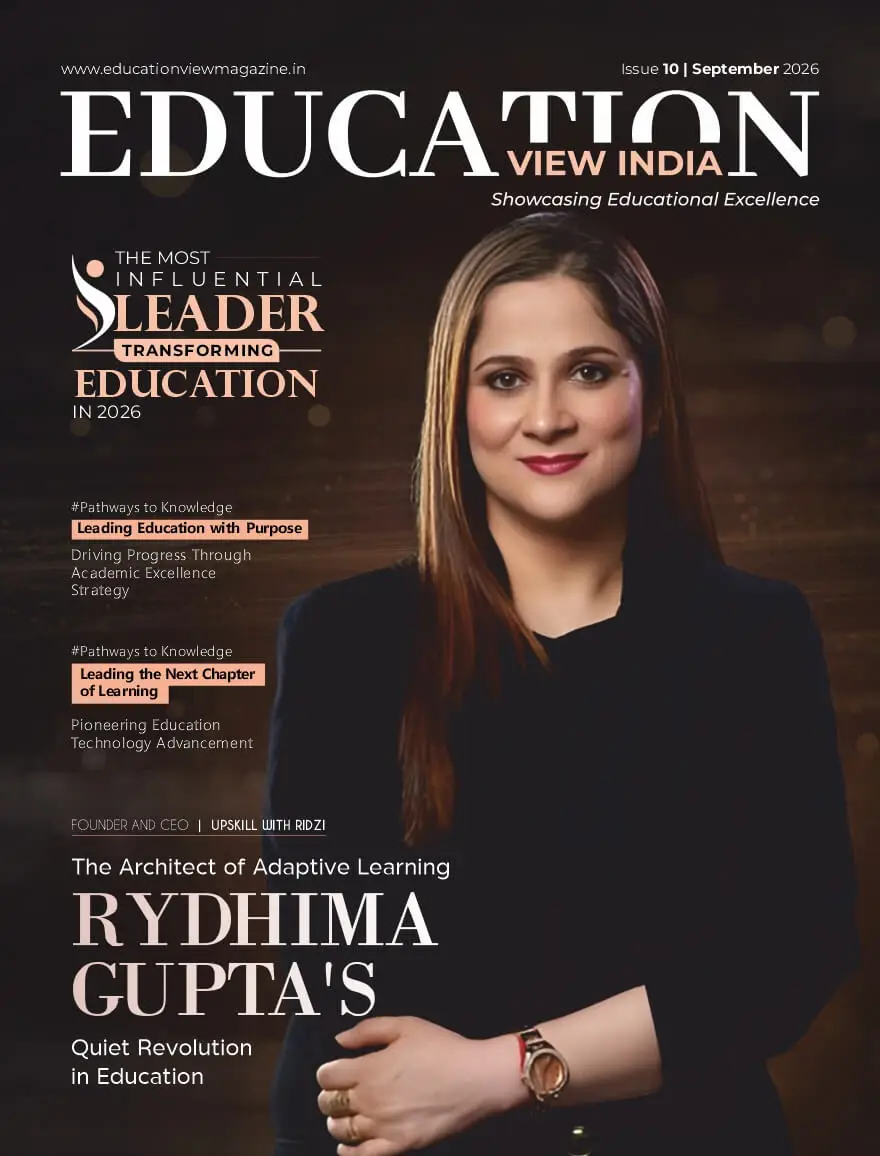
There is a particular kind of leader who does not announce transformation, she simply builds it, one learner at a time, until the scale of the change becomes impossible to ignore. Rydhima Gupta, Founder and CEO of Upskill with Ridzi, belongs to that rare category. Named among the most influential leaders transforming education in 2026, she carries none of the theatrics often associated with disruption. Instead, she carries a conviction that has quietly reshaped how thousands of learners, parents, and educators think about what education can be.
Gupta’s career doesn’t start with the formulation of a business plan. It begins with a fundamental question that she has asked herself throughout over a dozen years of teaching in classrooms all around the world – what if every learner was afforded the right kind of guidance? This question, seemingly simplistic, forms the foundation of everything she has done as an educator in various curricula (IB, IGCSE, GCSE, ICSE, CBSE), and now as someone who designs a learning environment for the whole world.
The unique element of her career path is not only the variety of curricula she has worked with, but the continuity of insights she gained from the variety. Teaching learners from different countries, from different socio-economic backgrounds and educational systems should have led to fragmented knowledge about education. But on the contrary, it helped her solidify her belief in certain constants within education – learners thrive in an education system which is personalized, meaningful and empowering, and they suffer if it is not. It is these beliefs, proved many times over through over a decade of practice in classrooms, that form her foundational thesis rather than temporary observations.
From Classroom to Continent
To understand Upskill with Ridzi, one must first understand the years that preceded it. Gupta spent over a decade teaching learners from radically different educational systems and cultural backgrounds, an experience that gave her something most entrepreneurs lack before they ever launch a venture: direct, repeated evidence of what works and what quietly fails. She noticed a pattern that troubled her. Exceptional students were not underperforming because they lacked capability. They were underperforming because the systems around them were built for uniformity, not individuality. At the same time, she watched talented, passionate educators want to innovate, yet find themselves without the resources, confidence, or technology to do so.
That dual observation- gifted students constrained by rigid systems, and capable teachers constrained by inadequate support, became the seed of Upskill with Ridzi, founded in 2023. For Gupta, entrepreneurship was never the goal in itself. It was, in her words, the vehicle through which classroom experience could become a movement. As she puts it,
“Entrepreneurship was never the destination. It became the vehicle through which I could transform years of classroom experience into a broader educational movement.”
That reframing matters. It signals a founder who did not chase a market opportunity and retrofit a mission to it. She built the mission first, and the organization followed as its natural expression.
Building an Ecosystem, not a Platform
What Upskill with Ridzi has become since 2023 reflects the scale of Gupta’s original ambition. The organization now delivers personalized academic mentoring across K-12 education, Business Management programmes, SAT English and Mathematics preparation, and internationally delivered French and Japanese language instruction, led by trainers based in Europe and Japan. It is a deliberately wide canvas, and Gupta is careful to explain why breadth matters as much as depth in her model.
Her guiding philosophy is that education should never force a learner into a predetermined mold. It should instead be architected around the learner from the outset. This is not a soft aspiration for Gupta; it is an operating principle she applies to every new initiative, every technological integration, and every partnership the organization considers.
“Education should never ask students to fit into a system. It should create systems that adapt to every learner,” she says.
This principle explains why Upskill with Ridzi resists being categorized as simply another online tutoring platform. She has consciously built a multidisciplinary ecosystem where academic mentoring sits alongside global language instruction and business competency training a structure designed to prepare learners not just for examinations, but for careers and opportunities that, as she acknowledges, may not yet exist.
Alongside academic content, she has embedded a parallel curriculum of competencies that rarely appear on a traditional transcript: critical thinking, creative thinking, storytelling, logical reasoning, leadership, and communication. She treats these not as enrichment extras but as core infrastructure for a learner’s future, arguing that academic excellence alone no longer equips a young person for the complexity of global careers. This is also where her commitment to educators becomes visible in practice. She has built continuous professional development, responsible technology adoption, and learner-centred classroom practices into the organization’s culture, on the premise that no learning ecosystem can outperform the confidence and capability of the educators sustaining it.
A Measured Relationship with Technology
No conversation about education in 2026 can avoid the subject of artificial intelligence, and Gupta engages with it neither as an evangelist nor a skeptic, but as a practitioner who has thought carefully about where the technology belongs. She is unambiguous that AI has real value: it can analyze learning patterns, personalize academic pathways, deliver instant feedback, and automate repetitive administrative work. What it cannot do, in her assessment, is replace the human relationships at the center of learning.
She reframes the entire industry debate around a single reoriented question. Rather than asking whether AI will replace teachers, she insists the more useful question is how AI can make teachers more effective. This distinction is not merely rhetorical, it shapes how her own organization deploys technology, positioning it as an enabler of mentorship rather than a substitute for it. A teacher, she notes, recognizes anxiety behind a smile in ways no algorithm can detect. A mentor understands that a student’s confidence often matters more than the content being delivered. These are not incidental observations; they form the operating philosophy behind every technological decision Upskill with Ridzi makes.
She distills this balance in one of her sharpest formulations: “Technology can accelerate learning. Compassion accelerates human potential.”
It is a line that captures the discipline running through her leadership: an insistence that innovation must always answer to a human purpose, never the reverse.
Milestones Measured in People, Not Plaques
Ask Gupta about the milestones that mattered most in her career, and she does not reach first for the Excellence in Education Award she has received, nor for the Pride of Bharat Award she is set to receive in Mumbai on 8 August 2026 though she speaks of both with genuine humility. Instead, she points to something less visible and far harder to quantify: transformation witnessed up close. A hesitant learner developing confidence. A student gaining admission to a university once thought unreachable. An educator rediscovering enthusiasm for their craft. A parent’s unprompted message describing a changed child.
For Gupta, these moments are not incidental byproducts of running an education company; they are the actual metric of success. This is a distinction she returns to repeatedly, and it reveals something important about how she evaluates her own work not by external validation, but by evidence of change in the people her organization touches.
She summarizes this philosophy plainly: “True educational success is measured not by the number of certificates or awards, but by the confidence we help people discover within themselves.”
This same instinct shapes how she talks about recognition more broadly. International platforms, speaking engagements alongside global policymakers, and representation at forums such as the Global Women Leadership Forum have given her a comparative view of education systems worldwide. Her conclusion from those exchanges is consistent: while systems differ by country, the aspirations of learners are strikingly similar they want to be understood, encouraged, challenged, and inspired.
Leadership Forged Through Difficult Decisions
Every entrepreneurial narrative contains its share of friction, and Gupta does not gloss over hers. One of her earliest and most persistent challenges was convincing people that personalized online education could be a genuinely transformative experience rather than a convenient substitute for in-person learning. Winning that argument required sustained credibility, built learner by learner, parent by parent, educator by educator.
A second, subtler challenge emerged as the organization began to scale: the temptation to prioritize rapid growth over sustainable quality. She describes resisting that temptation deliberately, evaluating every new programme, technology integration, or strategic partnership against a single test, whether it demonstrably improves the learner’s experience. If the answer is not an unambiguous yes, the initiative is paused and reconsidered. This is not the language of a founder chasing headline growth numbers; it is the language of someone protecting the integrity of what she built.
That discipline extends into how she thinks about leadership itself. Gupta describes humility as one of the most important lessons entrepreneurship has taught her, largely because education itself refuses to stand still shifting learner expectations, emerging technologies, and evolving career landscapes all demand that leaders remain students themselves. Her leadership philosophy, distilled into three commitments- lead with purpose, innovate with responsibility, and place people before processes reads less like a corporate values slide and more like a personal code she has tested under pressure.
“Leadership is not measured by the number of people who follow you. It is measured by the number of people who grow because of you,” she asserts.
A Decade-Long Vision for Education
Gupta’s outlook extends well beyond her own organization’s roadmap. She sees the next decade as one of the most consequential transformations education has experienced, driven by a fundamental shift in what education is even for. In a world where information is available instantly, she argues, the purpose of education can no longer be the transfer of knowledge alone. It must instead cultivate the capacity to interpret information, question assumptions, and solve problems that cross disciplinary and cultural boundaries.
This is where her vision of AI-enabled personalization intersects with her belief in enduring human values: empathy, integrity, creativity, ethical leadership, resilience, and communication. She predicts these qualities will become more, not less, important as automation expands, precisely because they are the qualities automation cannot replicate. She also anticipates education becoming increasingly interdisciplinary, blending business with technology and creativity with analytics, and increasingly international, as students learn across borders and cultures rather than within them.
Her long-term ambition for Upskill with Ridzi is not to become the largest education company in its category, but the most trusted a distinction she draws deliberately. It is captured most clearly in perhaps her most memorable statement: “The future belongs not to those who know the most, but to those who continue learning the longest.”
Advice Rooted in Purpose
When asked what she would tell aspiring educators and entrepreneurs entering the sector, Gupta resists offering a shortcut. Her advice begins with purpose rather than outcome: build with integrity, solve genuine problems rather than chase trends, and resist compromising quality for the sake of rapid expansion. To educators specifically, she stresses that subject expertise alone is no longer sufficient – empathy, patience, and adaptability now distinguish exceptional teaching from adequate teaching. To entrepreneurs, she is candid that the sector does not need more platforms; it needs ecosystems genuinely centered on the learner.
Her guidance is grounded in the same principle she has applied to her own career: that credibility compounds slowly, through consistent impact, not through speed. This belief in continual self-education- for teachers and founders alike- culminates in one of her most quoted lines:
“The best educators never stop being students themselves.”
Legacy as the Real Objective
Perhaps the most revealing part of Gupta’s reflections concerns legacy a subject she approaches without the usual language of institutional scale. She is candid that awards and titles, however meaningful, are not what she hopes will define her contribution to education. What she hopes will endure is something harder to measure: the opportunities created, the confidence restored, and the educators empowered to teach with renewed conviction.
She is equally direct in wanting to help redefine how success in education is measured altogether, arguing that examination scores, while relevant, should never be treated as the sole indicator of a learner’s potential. Confidence, creativity, resilience, and ethical leadership belong on that scorecard too. It is a position that runs through nearly everything she has built.
“The greatest legacy any educator can leave behind is not an institution- it is the confidence they inspire in others,” she states
A Message for the Next Chapter
Gupta’s closing reflections return, fittingly, to the tension she has spent her career navigating the balance between technological acceleration and human depth. She acknowledges that artificial intelligence is reshaping classrooms and expanding access to learning in ways previous generations could not have imagined. But she is equally insistent that this progress carries a responsibility: as education evolves, humanity must evolve alongside it, not be displaced by it.
At Upskill with Ridzi, that responsibility translates into a mission that extends beyond academic outcomes toward learners who are confident, adaptable, globally aware, and equipped to contribute meaningfully to society. Gupta’s ambition, ultimately, is not architectural but human. She is not building the largest educational organization in the market. She is building one of the most trusted, one learner at a time, one educator at a time, guided by the same question that started her journey more than a decade ago: what if every learner received the guidance they truly deserved?
That question, still unresolved in most education systems around the world, remains the quiet engine behind everything Rydhima Gupta continues to build.