Prime Highlights :
- A robotics company established a fully operational robotics centre at Shoolini University, where engineers worked directly with students and faculty on real projects.
- Students across engineering, biotechnology and pharmaceutical sciences are using AI tools in research, product development and healthcare-focused projects.
Key Facts :
- Shoolini University is one of India’s research-focused private universities and has 19 scientists featured among Stanford University’s top 2% researchers list.
- The university offers AI-focused learning through collaborations with AWS, Microsoft Azure, IITs and Algo8, along with an AI certification programme co-issued with IIT Ropar.
Background :
Shoolini University has strengthened its industry-linked education model by bringing hands-on robotics, artificial intelligence (AI) and research opportunities directly to students across disciplines.
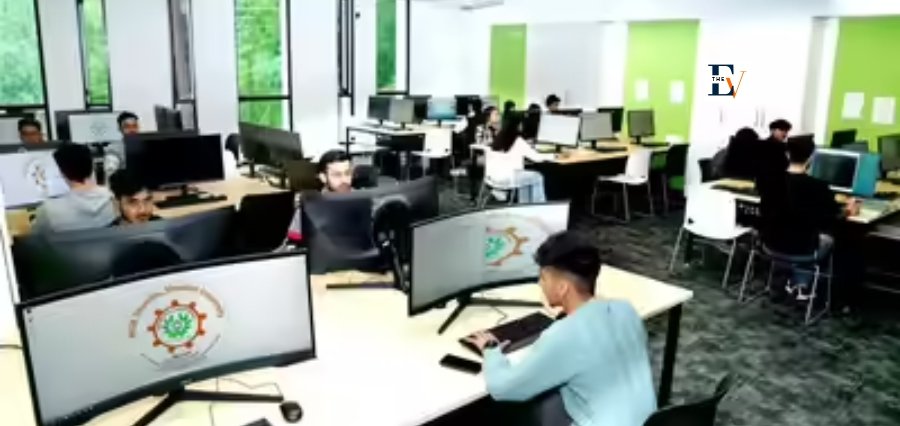
In April, a robotics company deployed its engineering team to the university campus for three months to establish a fully operational robotics centre. Engineers worked along with the students and professors and carried out applied robotics projects, faculty workshops, and on-site project developments. The project was focused towards giving practical industry experience as opposed to theoretical academic experience.
The university has integrated AI into its engineering curriculum through partnerships with AWS, Microsoft Azure, IITs and Algo8. Students in the B.Tech Computer Science and Engineering programme work on large language models, agentic AI systems and startup projects while studying.
Research-driven learning also extends beyond computer science. A team led by Associate Professor Gaurav Gupta developed an AI-based model designed to improve the early detection of breast cancer. The research is about how things integrate with hospital software and diagnostic applications, especially for rural healthcare.
At the School of Pharmaceutical Sciences, students use Python-based tools to analyse drug data and explore AI-assisted compound generation. During Pharma Anveshan, supported by BIRAC and the Department of Biotechnology, participants examined how AI can analyse genomic data and help identify disease-causing genes more efficiently.
The university’s research ecosystem is supported by a Bio-Innovation Centre funded through a ₹9-crore DST-PURSE grant. First-year students gain access to advanced scientific equipment and research opportunities under the Summit Research Program. University officials said students graduate with experience in live research, industry collaboration and AI certification, helping prepare them for future workforce demands.