Key Highlights :
- Apple joins hands with Synchron to implement brain-computer interface (BCI) technology on their devices.
- The partnership is designed to make the use of control of Apple devices by individuals who live with severe mobility impairment using brain activity.
Key Facts :
- Synchron’s Stentrode implant is inserted in the vein alongside the motor cortex of the brain to record neural signals to operate devices.
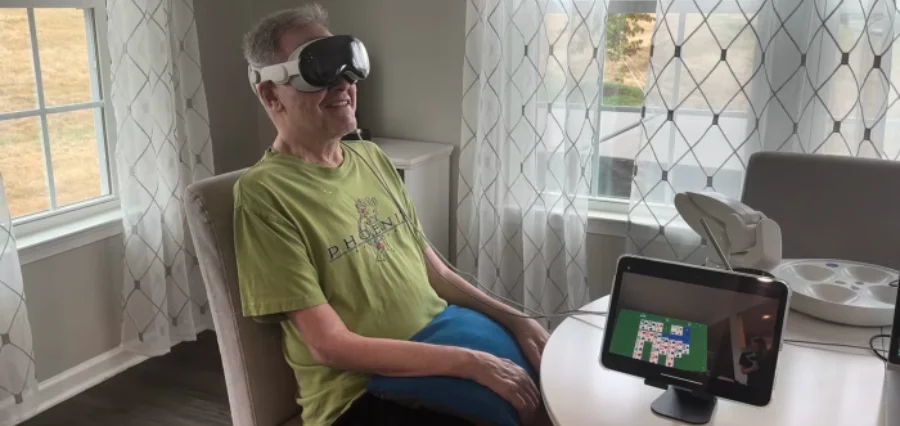
- ALS patient Mark Jackson is able to drive an iPhone, iPad, and Vision Pro headset successfully with the BCI.
- Apple plans to release a software standard to developers later this year, pending regulatory approval to access BCI.
Key Background :
Apple’s latest brain-computer interface (BCI) project is in partnership with Synchron, which developed a new BCI device. The objective of the collaboration is to allow people with severe mobility impairments—ALS (amyotrophic lateral sclerosis) or spinal cord injury patients, for instance—to operate Apple devices, i.e., iPhones, iPads, and Vision Pro headsets, through their brain signals.
It is where the focus is put on Synchron’s Stentrode implant, which is a minimally invasive device implanted in a vein close to the motor cortex of the brain. It records the neural signals and deciphers them to produce commands which can be used to control digital devices. The operation enables one to control his/her technology much more comfortably than under normal circumstances, particularly for individuals with limited mobility.
One of the success stories for this project is the achievement of Mark Jackson, who has ALS as a patient and is now able to use an iPhone, iPad, and the Vision Pro headset with the BCI. The reaction takes longer, but the achievement shows how BCIs are capable of enabling individuals to live to a certain degree with independence and interact with technology without any difficulty.
Apple’s suggestion is to develop a universal platform of software within a year so that third-party applications are easily integrated into BCI hardware. But that too has to go through the gatekeepers among the regulators first and it will not be soon.
The market for BCIs is anticipated to expand, and up to 150,000 Americans may benefit from the devices by 2030. Apple’s entry into BCI technology competes with Neuralink, but Synchron’s less invasive Stentrode device is a more accessible solution for those affected. The collaboration serves to emphasize the ever-growing role neurotechnology plays in making digital ecosystems within reach and available.