India’s education system has undergone a significant transformation with the introduction of the national education policy. One of the most talked-about changes is the shift from the traditional 10+2 system to a more holistic and flexible learning model. Naturally, many parents, students, and educators are asking: What is the 5-3-3-4 Structure? This new framework aims to align education with the cognitive development stages of children while promoting creativity, critical thinking, and experiential learning.
The Shift from 10+2 to a New Learning Framework
For decades, India followed the 10+2 schooling structure, which primarily focused on academic progression without deeply considering how children learn at different stages. The national education policy introduces a restructured model that divides schooling into four developmental phases: foundational, preparatory, middle, and secondary.
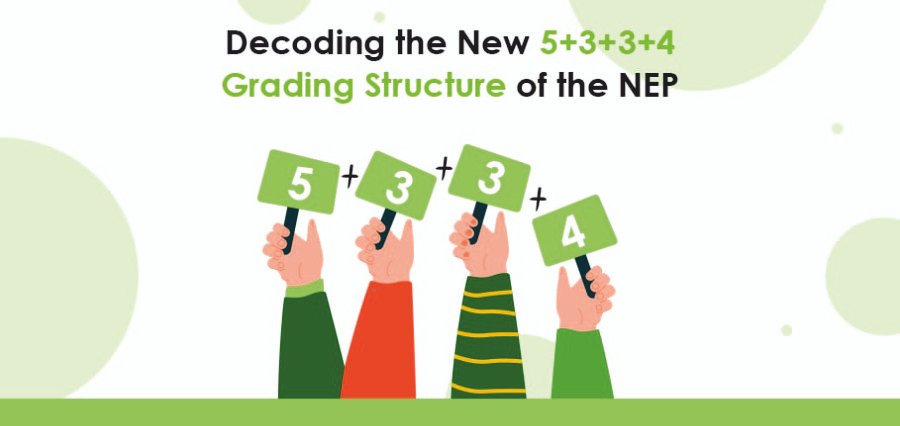
Understanding What is the 5-3-3-4 Structure? begins with recognizing how these stages are designed. The first “5” represents the foundational stage, covering ages 3 to 8, including pre-school and Grades 1 and 2. The next “3” corresponds to the preparatory stage (Grades 3 to 5), followed by another “3” for the middle stage (Grades 6 to 8), and finally “4” for the secondary stage (Grades 9 to 12).
This approach ensures that education is not just about completing grades but about nurturing a child’s mental and emotional growth at each step.
Foundational and Preparatory Stages: Building the Basics
The foundational stage is one of the most critical components of the national education policy, as it emphasizes early childhood care and education. At this level, learning is play-based, activity-oriented, and focused on developing language skills, motor abilities, and social interaction. The idea is to create a strong base rather than pushing formal academics too early.
As students move into the preparatory stage, the focus gradually shifts toward reading, writing, speaking, and basic arithmetic. However, the learning style remains interactive and engaging. This transition is designed to ensure that children do not feel overwhelmed while still gaining essential academic skills.
When exploring What is the 5-3-3-4 Structure?, it becomes clear that these early years are treated as a continuous learning journey rather than separate, disconnected phases.
Middle Stage: Encouraging Exploration and Critical Thinking
The middle stage marks a shift toward subject-based learning, where students are introduced to more structured academic content, including science, mathematics, arts, and social sciences. However, unlike traditional rote learning methods, the national education policy emphasizes conceptual understanding and critical thinking.
At this stage, experiential learning plays a major role. Students are encouraged to explore topics through projects, discussions, and practical applications. Coding, vocational education, and skill-based subjects may also be introduced, helping learners discover their interests early on.
Understanding What is the 5-3-3-4 Structure? also means recognizing how it prepares students for real-world challenges. By focusing on analytical skills and creativity, the system aims to move beyond memorization and foster genuine understanding.
Secondary Stage: Flexibility and Future Readiness
The final phase of the structure, covering Grades 9 to 12, is designed to provide greater flexibility and choice. Students are no longer restricted to rigid streams like science, commerce, or arts. Instead, they can select subjects based on their interests and career goals.
The national education policy encourages multidisciplinary learning, allowing a student to combine subjects like physics with music or economics with computer science. This flexibility reflects the evolving demands of modern careers, where diverse skill sets are highly valued.
Assessment methods are also expected to change, focusing more on application-based evaluation rather than high-pressure exams. This shift aims to reduce stress while promoting deeper learning.
When considering What is the 5-3-3-4 Structure?, this stage highlights how the system prepares students not just for exams, but for life beyond school.
A Holistic Vision for Education in India
The introduction of the 5-3-3-4 model under the national education policy represents a paradigm shift in how education is delivered and experienced in India. It acknowledges that children learn differently at different ages and seeks to create an environment that supports their overall development.
By integrating early childhood education, promoting flexibility, and emphasizing skill development, the policy aims to create a more inclusive and forward-thinking system. The focus is not only on academic excellence but also on nurturing well-rounded individuals who can adapt to a rapidly changing world.
Ultimately, understanding What is the 5-3-3-4 Structure? helps in appreciating the broader vision behind the reform. It is not just a structural change but a reimagining of education itself—one that prioritizes curiosity, creativity, and lifelong learning.