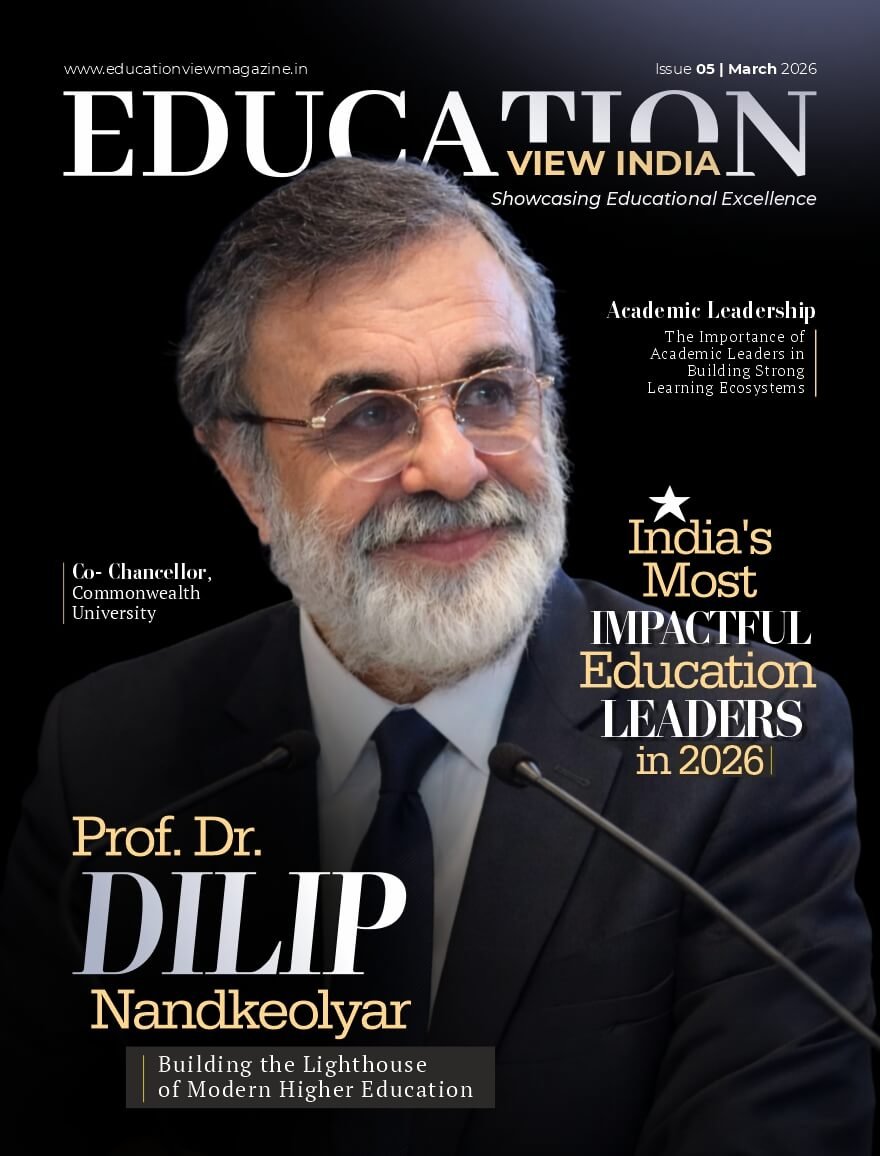
“Innovation without integrity is noise; integrity without innovation is stagnation.”
The higher education system in India is at a crossroads. The pressure is on the institutional level as the institutions that are racing to match NEP 2020, which is why it is Prof. Dr. Dilip Nandkeolyar who is one of the few to directly address the pressure upon him: he is not a philosopher of education, but he is a systems architect and higher education transformation strategist who has been working with the challenges of turning good intentions into practical business reality over decades.
On many Indian campuses, the conversation sounds familiar: syllabi are revised, electives announced, and leaders speak the language of multidisciplinary learning. Yet recruiters, faculty, parents, and students return to a practical question—what actually changes in the daily reality of teaching, mentoring, assessment, and accountability?
Sector observers argue the challenge is not a lack of pilots but a lack of coherence. Institutions run innovative pockets—industry projects here, a new minor there; a mentoring cell elsewhere—yet students experience them as disconnected episodes rather than a unified journey. Accreditation frameworks encourage documentation, but documentation alone does not guarantee readiness. Universities that sustain global reputation institutionalise execution, so outcomes do not depend on personalities. Dr. Nandkeolyar’s argument sits squarely in this space: move from scattered innovation to a durable operating model.
The National Education Policy (NEP) 2020 sets out an ambitious direction: flexible curricula, experiential learning, competency-based outcomes, assessment reform, teacher empowerment, and stronger global competitiveness. What NEP 2020 does not prescribe is a single method of execution. That gap—between intent and delivery—is where Prof. Dr. Dilip Nandkeolyar locates the most stubborn friction in higher education reform.
Across decades of interviews and advisory work, he has maintained that India does not suffer from a shortage of vision; it suffers from a shortage of reliable execution. The sector has produced declarations, committees, and episodic islands of excellence, but struggled to build a repeatable system that converts policy intent into consistent capability outcomes.
His response is Gurukul 2.0: a modern educational operating system designed to align outcomes, pedagogy, mentoring, assessment, faculty capability, industry engagement, student support, and governance into a coherent delivery engine. “NEP gives the WHAT; Gurukul 2.0 provides the HOW,” he says, framing it not as another initiative but as an architecture for implementation.
A Systems Designer in a Sector Addicted to Declarations
Those who have worked with Dr. Nandkeolyar often describe him less as a conventional academic leader and more as a systems architect and higher education transformation strategist. Early in his career, he observed a recurring pattern: many graduates were qualified yet struggled with real decisions at work. They could reproduce concepts but not consistently apply them under constraints. They spoke the language of ethics yet faltered when incentives were misaligned.
Faculty privately acknowledge the same tension. Time-bound semesters, high-stakes exams, and content-heavy syllabi reward memorisation and speed more than reasoning and judgement. Employers, meanwhile, seek evidence of communication, collaboration, accountability, and sound decision-making—capabilities that do not reliably emerge from lecture-and-exam routines.
For him, these are not isolated teaching gaps but operating model failures. If institutions repeatedly produce capable exam-takers yet inconsistent professionals, the solution cannot depend on star faculty or motivational speeches. It must be embedded in the system, so quality becomes repeatable and measurable.
He has enrolled institutions struggling with such downfalls over the years, where he has counselled on redesigning curriculum, faculty development models, assessment systems, and governance systems that endure beyond the replacement of one leadership by another. His advisory experience with organisations such as WASME and QNext Global Certification has provided him with firsthand experience of the implementation gap: the gulf between the promise of policy and what an institution actually provides in the field.
Gurukul 2.0 aims to create that design. It connects what is taught, how it is taught, how learning is evidenced, how faculty are enabled, how mentoring is structured, and how governance ensures continuity.
Why an Operating System Is Non-Negotiable
Higher education is often managed as a collection of subjects and calendar events. Dr. Nandkeolyar reframes it as a national capability system requiring cadence, feedback loops, measurement, and continuous improvement.
Persistent obstacles to reform are widely recognised: inertia, fragmented governance, incentives rewarding appearances, and misalignment between academic and industry timelines. When execution fragments, reforms become performative announced, celebrated, then diluted by operational reality. Quality becomes personality-dependent rather than process-driven.
Gurukul 2.0 seeks to close that gap. Its premise is straightforward: policy intent must translate into operational practices institutions can sustain without erasing uniqueness. The operating system does not dictate a single curriculum; it defines the conditions under which any curriculum produces capability.
The Architecture of Gurukul 2.0
At its core, Gurukul 2.0 is a set of interconnected design choices—an Operating Model of Excellence meant to make outcomes repeatable across cohorts. Its architecture rests on six linked components:
- Capability-based, evidence-visible Outcomes: The outcomes must be capability-based, evidence-based, and visible to students and employers.
- Application and Judgment-first Pedagogy: pedagogy must privilege application, judgment, and decision-making over recitation.
- Structural Mentorship (peer, faculty, industry, reverse): Mentorship and reverse mentorship must be structural roles, not optional extras.
- Authentic Assessment (projects, simulations, portfolios, vivas): Assessment must test reasoning, synthesis, and authenticity of work.
- Continuous Faculty Capability Building: Faculty capability building must function as continuous professional practice rather than episodic training.
- Evidence-driven Governance on Cadence: Governance must operate on cadence, reviewing evidence, closing gaps, and driving improvement.
Each element is necessary but insufficient alone. Together, they form a coherent operating system with aligned processes and incentives.
The Compass of Integrity
Integrity has become an urgent concern, particularly in assessment, as Artificial Intelligence tools reshape what is easy to produce and what is difficult to verify. Institutions worldwide grapple with preserving standards when drafting, summarising, and coding can be outsourced to machines.
Dr. Nandkeolyar treats integrity not as moral rhetoric but structural design. Innovation must be responsible experimentation: piloted at manageable scale, with predefined success criteria, and scaled only when evidence supports it. This prevents dramatic transformations followed by fatigue and rollback.
In the Gurukul 2.0 model, assessment becomes the real curriculum. Instruments include live projects, simulations, decision memoranda, portfolios, and viva-style defences. These make copied work harder to submit and reasoning easier to evaluate. Citation literacy is explicitly taught. Responsible AI use is also taught, with disclosure norms so AI becomes a capability amplifier rather than a threat.
“Purpose keeps education human and ethical; precision makes outcomes repeatable,” he says, pairing stewardship with operational rigour.
Mentorship as Infrastructure
Mentorship often features in brochures yet remains peripheral. Gurukul 2.0 embeds it structurally. Capability formation requires observing judgement in action—how professionals decide, recover from mistakes, and manage conflicting incentives.
The model designs layered mentoring: peer mentoring for belonging and navigation; faculty mentoring for cognitive development; industry mentoring for workplace judgement. Reverse mentorship recognises that younger learners often command emerging tools and cultural fluency. Structured exchange benefits both sides: seniors gain updated literacy; juniors gain ethical anchors and decision discipline.
By integrating mentorship into workload, calendars, and accountability, the system shifts from charismatic intervention to scalable design.
From Placement to Readiness
Institutions often measure success through placement statistics. Dr. Nandkeolyar reframes employability as a learning system outcome rather than a placement office achievement.
This shift reshapes the academic year. Students build portfolios—decision notes, analyses, prototypes, documented projects—that withstand scrutiny. The focus moves from syllabus completion to demonstrated capability.
Industry engagement becomes structured partnership: live briefs, employer councils, and feedback loops informing relevance without surrendering academic independence.
Three Horizons of Readiness
The operating system remains stable while tools evolve. Dr. Nandkeolyar explains this through three horizons.
Horizon 1 centres on timeless capabilities: critical thinking, communication, ethical judgement, numeracy, and continuous learning. These form the spine.
Horizon 2 addresses current tools and practices: data literacy, responsible AI use, collaborative platforms, and industry methods. Tools are governed through disclosure norms and evidence-based assessment.
Horizon 3 anticipates emerging shifts: agentic AI, modular credentials, green skills, and new work forms. Here adaptability is paramount—graduates must update skills without losing ethical compass.
This model neither denies disruption nor romanticises it. Disruption becomes a design constraint rather than a marketing slogan.
The Faculty Question
No operating system exceeds the capability of its builders. Faculty development therefore sits at the centre of execution. The issue is rarely commitment; it is often the absence of an enabling environment that supports teaching for capability instead of coverage.
Gurukul 2.0 positions faculty capability building as continuous professional practice. It emphasises instructional design, assessment design, mentoring competence, and applied research orientation. Peer observation and reflective practice become cultural norms, improving teaching through evidence rather than hierarchy.
In an era when faculty must integrate AI and new pedagogies without adequate support, a system demanding innovation without building capability produces compliance theatre. An enabling operating system produces genuine transformation.
Governance that Looks at Evidence
Many reforms fail because governance does not examine evidence frequently enough. Gurukul 2.0 emphasises cadence: regular review of learning artefacts, mentoring participation, assessment quality, and student outcomes.
Announcing experiential learning is easier than verifying authentic work, mentor engagement, and judgement-testing assessments. Precision here means disciplined execution, converting aspiration into operational reality.
An Impact Scorecard
To make accountability practical, the system proposes a balanced scorecard. Leading indicators include portfolio quality, authenticity of assessments, mentoring participation, and reflective faculty practice. Lagging indicators include employer feedback, role quality, early-career progression, and alumni evidence of continued growth.
The goal is not more reporting, but an actionable feedback loop guiding leaders toward timely intervention. Reputations increasingly rest on demonstrable outcomes rather than claims.
Addressing Scepticism
Ambitious reform invites scepticism. Some fear operating system language mechanises education; others warn capability frameworks can become performative.
Dr. Nandkeolyar argues the metaphor professionalises execution rather than reducing learning to mechanics. Education remains relational and contextual; the operating system provides scaffolding so human work—teaching, mentoring, ethical formation—can be delivered reliably.
Gurukul 2.0 is thus less a rigid template than a disciplined way of working: define outcomes, design learning, test authenticity, build faculty capability, measure evidence, improve continuously.
Why It Matters Beyond India
Although designed with Indian realities in mind—scale, diversity, uneven preparedness, urgent employability—the model is not merely local. Many higher education systems reward credentials yet struggle to produce consistent capability under real-world conditions.
By making capability formation operationally explicit, Gurukul 2.0 offers vocabulary and execution discipline adaptable across contexts facing technological acceleration and labour market shifts.
Leadership Beyond Applause
Dr. Nandkeolyar’s public profile spans corporate stewardship, academic leadership, and advisory roles, including associations with WASME, NetocoreInfo Business Group, Commonwealth University, and QNext Global Certification. Yet his defining stance is that reform must be engineered, not announced.
In recent years, institutions have approached him not for ceremonial endorsements but for system design—how to convert intention into a delivery model resilient to leadership changes, cohort variability, and operational constraints. He is an execution-oriented reform thinker, and he applies this discipline to all forms of engagement. Gurukul 2.0 is designed to co-create, build capabilities, and sustain execution across institutions of any size.
The Call That Cannot Be Postponed
Higher education stands at the intersection of national ambition and individual survival. Students make high-stakes decisions with limited margin for error. Employers navigate complexity. Faculty face pressure to innovate. Institutions compete globally while serving local responsibilities.
It is on this backdrop that Gurukul 2.0 is not another reform to proclaim and put away. It is a system that is designed as an operating system for institutions that can no longer afford the difference between aspiration and delivery.
To pressured-to-deliver-results vice chancellors, boards of directors building trust, faculty still grappling with more rapid change, and students who seek more than an exam-passing machine. He gives us something unusual, a framework which does work in practice.
“Innovation without integrity is noise; integrity without innovation is stagnation.” The line returns as a test. If institutions can build systems that hold both together, they can graduate individuals who do not merely pass examinations but can think clearly, decide responsibly, adapt confidently, and lead with integrity in a world that demands both competence and character.