From every generation of Indian education emerge a few leaders who do not make the hard choice of ideals. They combine rigour and warmth, and they create structures but do not forget the humanity that the structures need to serve. Such leaders are never self-promotional. You see their presence in the confidence of a child, in the development of a teacher and in the ethos of a school. With classrooms in India turning towards competency, critical thinking and holism, such leadership becomes increasingly relevant.
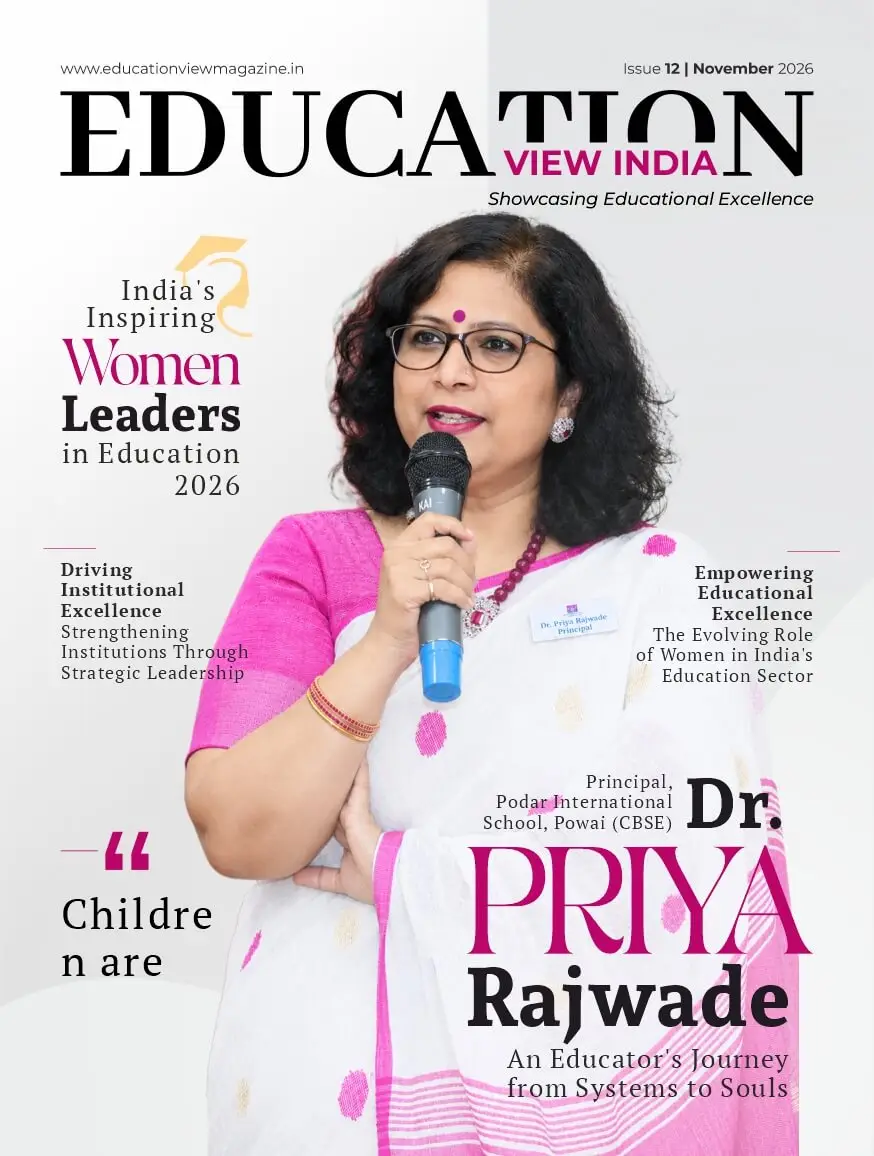
Dr. Priya Rajwade is one such leader. She is Principal at Podar International School Powai, a coach and a perpetual learner. She heads a school with 3,800 children and 160 teachers. Her journey to becoming a school principal did not follow a straight path. It went through a microbiology lab, a quality control department of a pharmaceutical company and an arduous journey of developing herself as a leader.
A Journey in Layers
Dr. Rajwade began her career as a lecturer in Microbiology. Science gave her a curious mind and a respect for evidence. She then moved into the pharmaceutical industry, where she worked in quality control and met the demands of ISO and USFDA audit processes. The work taught her discipline, documentation and attention to detail. It also taught her that quality cannot be inspected into a product at the end. It has to be designed into the process from the start.
She kept teaching throughout, and the classroom gradually claimed her. “Education was my true calling,” she says, and the transition tested her. She held no professional degree in education at the time, and she admits that, as a young and confident teacher, she believed she did not need one. That belief did not last. She soon recognised that a professional qualification was an essential step in understanding how teaching and learning work, so she earned her BEd and began what she calls her real journey in the field.
Many people questioned the change. They asked whether she had wasted years by arriving in education late. She disagreed then and disagrees now. She argues that a school, like any complex organisation, needs systems, processes, data and accountability, and she brought all four with her from the laboratory and the audit room. She also recognised the difference. A school does not make products. It serves human beings, each with a distinct personality, context and emotional world. That conviction became the foundation of her leadership philosophy. “Systems must coexist with empathy,” she says.
A Student for Life
Dr. Priya never stopped studying. Her qualifications include postgraduate degrees in Microbiology and in Education, Guidance and Counselling, along with management studies. She completed transformational leadership at XLRI Jamshedpur and strategic leadership at IIM Ahmedabad, and she holds certifications in coaching and training. She now serves as a certified CBSE trainer, an Emotional Intelligence coach and a corporate trainer. Her doctoral research explores how the principles of continuous improvement and quality thinking can serve holistic student development. She declines to discuss unpublished findings, but she says the work has reinforced a belief she has long held: examination results alone cannot measure educational quality.
She applies the same curiosity to her reading. Psychology, leadership, motivation and human behaviour fill her shelves, and she wants to understand why people act as they do and how experience shapes them. She follows Howard Gardner’s Five Minds for the Future closely. The framework describes the disciplined, synthesising, creating, respectful and ethical minds, and she treats it as a guide to the kind of human beings schools should develop. Her recent reading of Range sharpened another long-held view, the value of “desirable difficulty.” In her view, growth does not come from making everything easy. Children need room to struggle constructively, make mistakes, persist and discover that they can do more than they imagined.
Building People and Systems
Her career has taken her across institutions, boards and cities. She has worked with State Board, CBSE, ICSE and Cambridge curricula, and the experience convinced her that curricula may differ while the purpose of education stays deeply human. She credits the Podar group with shaping her most. There she found leaders who were forward-thinking yet grounded, and they gave her the trust to try new ideas without fear of failure. She says that everything she knows about leadership, inclusivity and genuine care for students she learned there.
An association with the Ashoka group stands out among her experiences. She helped launch a new Cambridge curriculum school and contributed to every stage of the process, from school design and staffing to budgeting, liaison, branding, marketing and parent orientation. The school received its Cambridge affiliation during her tenure. The assignment also took her from Mumbai, her home for nearly all her life, to Nashik. She describes the move as far more than a professional stretch. In a smaller city she felt a personal connection with students and teachers that larger cities often lack, and she saw how family and community shape the young.
Change, she says, has been the defining challenge of her career. She has navigated professional, geographical and organisational change, along with the shifting expectations of parents and society. She faces it with an appetite for risk. “When we focus only on the uncertain, rather than on the future, we tend to exaggerate the threat,” she often says. In her view, uncertainty invites innovation, collaboration and learning. Three people guide her when challenges arise. Her coach, Bhaskar Natarajan, urged her to be a giver and never a matcher. Her teacher, Prof. Manish Singhal, asked what she was putting in her shopping cart, a reference to the labels and influences people collect without examining. Gaurav Podar asked, simply, whether she had thought a decision through.
Rigour Without Losing Humanity
Her pharmaceutical background explains why Dr. Priya sometimes says, deliberately provocatively, that educating a child should aspire to be a Six Sigma process. She does not mean that children are products. She means that the stakes are too high to accept avoidable failure. A mistake in education can shape a life trajectory, and she believes children deserve extraordinary care, rigour and responsibility.
She remains cautious about borrowing industrial models uncritically. A child who earns excellent marks but cannot think independently, accept feedback, regulate emotions or take ownership of learning has not received a complete education, she argues. She pairs quantitative feedback such as scores with qualitative feedback such as values, thoughts and emotions, and she sees that pairing as the crux of holistic development and of the vision in NEP 2020.
Her research has also shaped how she reads children’s behaviour. Today’s children, she observes, are brilliant, vocal and reflective. They are also easily distracted, accustomed to instant gratification and often lonely even in a crowd. When a child struggles, she believes educators should ask a different question. Instead of asking what is wrong with the child, they should ask what is happening in the system that produces the behaviour. She often invokes the proverb that it takes a village to raise a child, and she believes society has not always served its children well.
Leadership as Cultivation
Dr. Priya describes her own leadership as a blend of empathy, high expectations and continuous learning. She believes people perform best when they feel seen, respected and trusted. She also believes that care must never lower standards, and that genuine care sometimes means holding people accountable because she believes they are capable of more. Her core values are empathy and gratitude, and she tries to lead with both head and heart.
She measures her success through the people around her. She has mentored colleagues and members of leadership teams and has encouraged them to pursue higher education and professional growth. Some have since become principals themselves, and a few have surpassed her own achievements. “Leadership is not about being the most important person in the room. It is about making the room capable of doing important things,” she says.
Her identity as a woman has also shaped her approach. She does not claim empathy, compassion or strength for women alone, because she regards them as human qualities. She does argue that women need not suppress the feminine qualities of love, compassion and empathy to prove themselves effective. Listening is not weakness, in her view, and emotional intelligence is a strength in a profession where the people being led include young children, anxious teachers and parents balancing demanding lives. She advises young women leaders to know themselves, keep learning, accept difficult assignments, reject limiting definitions of leadership and lift others as they rise.
The Measure of Impact
Her school offers one set of measurable results. It has recorded a 100% Grade X result across seven batches, and its students have represented the school in national and other competitive sporting arenas. Her profile also records a Leadership Award for 2025–26.
The honours collected along the way include the Iconic Woman Award 2024, Mumbai’s Top 25 Educators Award 2024, India’s Visionary School recognition, Top Influential Principal of the Year, the Pleasing Principal Award, the SCLRCC Educators Award, the World Educators Awards, the Inspiring Educators of Maharashtra Award and the Time Education Icons Mumbai recognition. She values them as acknowledgements of a larger team’s work, and she treats them as by-products of that work. The moments she remembers longest are quieter. A student overcomes an inner struggle. A teacher discovers a capability she did not know she had. A former colleague calls to say that something she taught is still helping.
A Poet’s Language
Dr. Priya also writes poetry, which she describes as another language for what education cannot always express. Poetry and education, she says, share one purpose: the attempt to understand human experience. Her spiritual outlook reinforces the habit of learning from every person and every experience, including the unpleasant ones.
The Boldest Dream
Her ambitions go beyond one institute. She wishes to create an environment in which academic excellence and humanity never clash. Her dream is to make children who not only learn thoroughly but also think independently and cooperate with generosity and who take criticism and hardship bravely. Furthermore, she wants a society where teachers are treated as seriously as any other profession since they shape lives just as much as doctors do. She dreams of an education system in India based on its culture and values, aware of the global world and future-oriented, producing people who can compete but will never become cruel, succeed but won’t be arrogant and lead but will never dominate.
“Children are not just our future; they are our gift to the future. In a world that is so uncertain the best gift that we leave for posterity is children who are humane,” she says.
She wants the readers to know that her profile shouldn’t talk about the achievements. She sees her career as a chance to learn and serve and reflects on it proudly because she knows that she has served her duty with sincerity and resilience. She also wishes for the readers to share some of their journey with her. Even after all the degrees, certifications and leadership experience, she still introduces herself first as a learner.
Her philosophy fits in a single thought. “We are not merely preparing children to live in the world we have created. We are preparing them to create the world that comes next,” she says.